
What the Sims 4 Online Studio CAS Viewer Brings to Modders
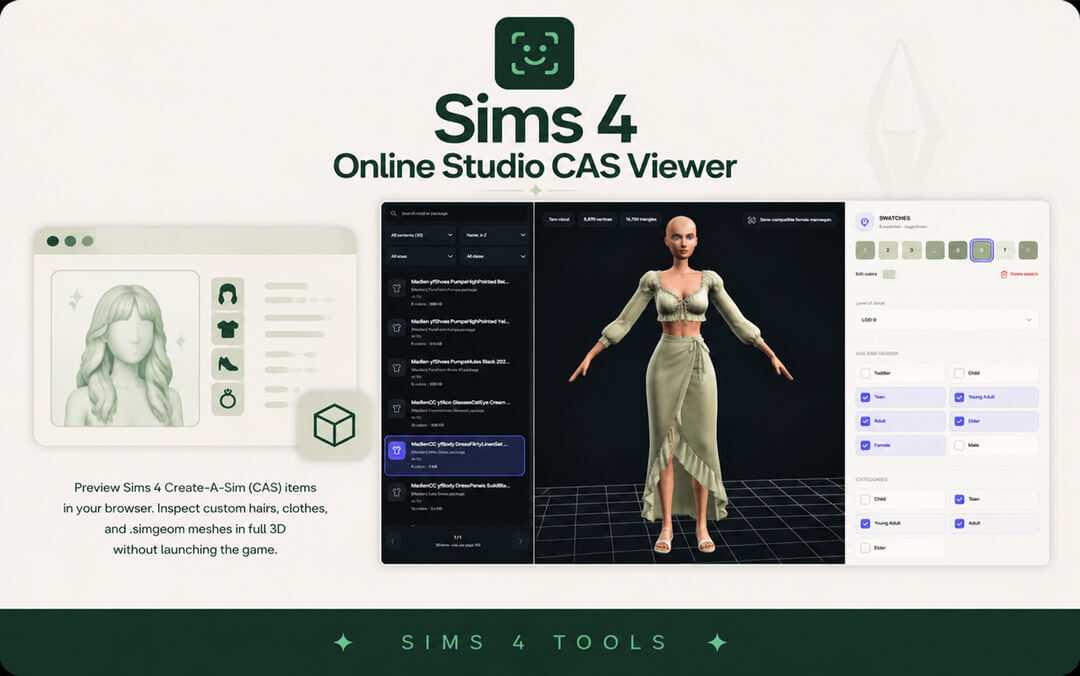
Previewing Create-a-Sim custom content has always been a notoriously sluggish process. To test whether newly downloaded hairstyles, dresses, or skin details look good on a Sim, players typically have to launch the game, sit through lengthy loading screens, and navigate the sprawling CAS catalog. If a package turns out to be poorly rigged or visually unappealing, removing it requires closing the game and hunting through folders. The Sims 4 Online Studio CAS Viewer solves this long-standing headache by providing an instant 3D model viewer directly in your web browser. Hosted on Simsmodly, this powerful web utility lets players and creators inspect clothing meshes, examine swatches, and verify textures without ever opening the game client, making it an essential resource in The Sims 4 custom content modding toolkit.
Operating completely within modern browsers with zero software installation required, the viewer allows you to drag and drop any CAS `.package` file to immediately view the 3D garment rendered over a standardized Sim mannequin.
Whether you are cleaning out hundreds of outdated clothing files or auditing your own custom meshes before release, this tool greatly accelerates the speed of your mod curation workflow.
Feature Overview and CAS Inspection Capabilities
The CAS Viewer brings professional-grade asset inspection tools directly into a lightweight web environment.
Interactive 3D Sim Mannequin Viewport
The tool displays CAS garments draped over an accurate 3D Sim body form. Using smooth orbital mouse controls, you can zoom in to examine collar stitching, rotate to inspect back seams, and pan up to verify hairline transitions. This reveals joint rigging and mesh boundaries clearly before you ever place the file into your active game.
Comprehensive Swatch and Texture Inspection
The viewer automatically parses internal package definitions to display all author-created color swatches. Clicking through the swatch palette updates the 3D model instantaneously, allowing you to check diffuse texture resolution, inspect normal maps for fabric wrinkling, and review specular maps for unwanted shine.
Polycount and LOD Auditing
Unoptimized clothing with excessive polygon counts is the leading cause of CAS lag and in-game performance drops. The CAS Viewer displays exact vertex and triangle counts for every mesh. It also allows you to toggle between LOD0, LOD1, LOD2, and LOD3, ensuring that proper low-detail distance meshes are present to prevent game stuttering.
Practical Benefits for CAS Curators and Creators
The Online CAS Viewer provides immense practical value across several customization tasks.
Fast CC Folder Pruning
Every Simmer accumulates hundreds of clothing downloads that end up unused. Instead of testing files inside the heavy game client, you can drag your entire downloads folder through the viewer, previewing each garment in seconds and instantly discarding items that fail to meet your quality standards.
Creator Testing and Debugging
For CC creators, the tool allows rapid verification of bone assignments, transparency sorting, and texture mapping. You can verify that normal maps cast accurate shadows and that texture seams match cleanly at the shoulders and waistline before publishing your work to the community.
Privacy and Web Performance
All file parsing occurs locally in your browser memory, ensuring your custom packages remain private and secure while delivering lightning-fast rendering performance.
Streamlining Mod Folder Management and Troubleshooting
Maintaining a large custom content collection in The Sims 4 can quickly become a complex logistical challenge. Between game patch updates, broken packages, conflicting tuning scripts, and corrupted cache files, players spend substantial time managing external files rather than actually enjoying the game.
Having dedicated tools designed to inspect, edit, and organize package files without launching the heavy game client saves countless hours of troubleshooting. Instead of enduring ten-minute loading screens just to identify a single broken clothing item or glitched chair, players can inspect package contents, preview 3D geometry, and verify texture maps directly in a lightweight external environment.
This efficiency transforms the modding experience from a stressful maintenance chore into a smooth, organized workflow, allowing players to curate their digital worlds with confidence and stability.
Empowering Creators and Translators in the Modding Community
Beyond personal mod folder organization, accessible tools play a pivotal role in empowering community creators, translators, and aspiring modders. Lowering the technical barrier to entry encourages more players to contribute custom content, localized translations, and gameplay enhancements.
When localization tools allow fast string editing and package reorganization without requiring complex programming environments, modders worldwide can collaborate easily to translate popular mods into multiple languages. This fosters a more inclusive, connected global Sims community where players can experience storytelling in their native language.
Whether you are an active creator polishing your latest CC release or a dedicated player translating your favorite gameplay overhaul for friends, streamlined utility tools form the backbone of modern Sims 4 customization.
Safe Modding Practices and Update Workflows
Every major game patch brings the possibility of outdated mods causing script errors or UI glitches. Having structured external tools simplifies the process of testing packages before placing them back into active save files.
By inspecting package resource IDs, tuning instances, and conflict logs externally, players can isolate broken content quickly without risking save file corruption. Establishing regular maintenance routines with reliable tools protects your gameplay progress and keeps your custom content collection healthy over years of play.
Cross-Platform Accessibility and Performance Benefits
A persistent obstacle for custom content enthusiasts has been operating system limitations. Traditional desktop utilities often required Windows operating systems with specific framework dependencies, leaving macOS, Linux, and mobile web users with few native options for mod auditing.
Browser-based modding utilities eliminate these operating system barriers. By leveraging web standard technologies, players can inspect packages, audit thumbnails, and organize content from any modern laptop or desktop setup. This universal accessibility empowers a much wider slice of the global player base to curate clean, stable custom content collections without wrestling with complex system installations.
Building Sustainable and Organized Mod Collections
Long-term enjoyment of modded gameplay relies heavily on keeping file hierarchies clean and organized. Over years of playing across multiple expansions, duplicate assets, conflicting overrides, and broken tuning files can accumulate unnoticed.
Utilizing dedicated web tools to audit package names, verify internal resource types, and inspect thumbnail assets before moving files into active Mods directories prevents clutter at the source. Players can establish structured subfolder hierarchies—such as categorizing by creator, content type, or gameplay pack—ensuring that patch day maintenance takes only minutes rather than hours of stressful file hunting.